From the Colonel:
15th Iowa Infantry
Uniform and Equipment Guidelines
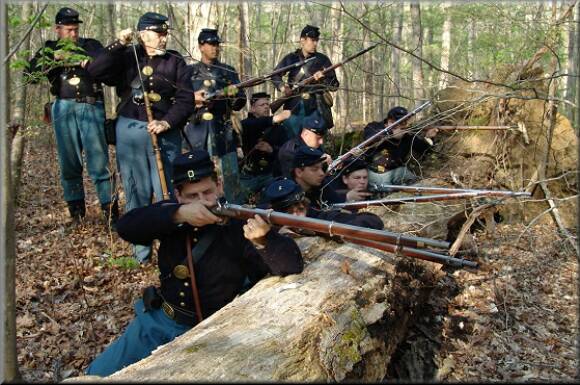
Guidelines: As we are to portray a new regiment recently outfitted, it is our desire that we present as uniform an appearance as possible. While many of us put on our personal style and stand out by doing so, it’s our desire that if you must do that, do it with a shirt, a camp hat, with something that is not part of government issue clothing and accoutrements. By presenting a regiment that is almost entirely uniform we will most accurately portray the 15th Iowa, and will give a very impressive image to all who see us. Without requiring you to go to any great expense to fall in, this is the event where you will want to strive for conformity by making the first item in the list below your first choice. What is listed below is taken from known information of what the 15th had, or goes to regulations if a specific item is not precisely identified. All items are to be of period material and construction.
Coat: Fatigue Blouse/Sack Coat very strongly preferred, dress frock or infantry jacket reluctantly accepted if you don’t have, or can’t buy or borrow a sack coat. Try hard to find a sack coat.
Pants: SKY blue trousers only accepted. No dark blue trousers except by officers if so desired. Sky blue trousers had become the regulation three months prior to the 15th being uniformed in St. Louis. While we have not found a reference to sky blue, the quartermaster department in St. Louis was clothing regiments literally by thousands of trousers for three months since the regulation change to sky blue. And it is not the intent of the regiment organizers to require every man to buy a new pair of dark blue trousers to attend. Sky blue is the required color for enlisted trousers.
Suspenders/Braces/Belt: Trousers may be held up by either method provided period construction and materials are used.
Underwear: Military issue preferred, civilian or none is accepted. No modern underwear.
Hat: Hardee with a Jeff Davis eagle pinning up the LEFT side brim and the hat devoid of all other hat trim is very strongly preferred. Really try to get a Hardee hat. Black slouch hat reluctantly accepted. Forage cap strongly discouraged (except for officers), but accepted.
Shirt: Military wool regulation or contract preferred, civilian cotton accepted.
Socks: Wool preferred, cotton accepted. You should have an extra dry pair with you.
Footwear: Military pattern brogans strongly preferred, boots accepted. You will be marching five miles in your footwear so choose wisely. Break them in long prior to the event or you’ll be very sorry.
Eyeglasses: Only period eye wear accepted. Contact lenses are accepted. NO modern eyewear at all.
Rifle: Springfields are what they were issued, so Model 1855 and 1861 Springfields are strongly preferred. Model 1863 Springfields and Enfields are accepted. Smoothbores are strongly discouraged, but accepted if that’s all you have. Military flintlocks and civilian rifles are NOT accepted.
Bayonet and Scabbard: Appropriate model bayonet for your rifle. Scabbard of black leather, Federal two rivet model with brass finial preferred. Seven and eight rivet Federal models accepted. Confederate Black leather, tin tip and lead ball tip scabbards are reluctantly accepted if you do not have a Federal model. Other Confederate models, i.e. sewn tip, are not accepted.
Leathers: Black leather belt without brass keeper (with leather loop or nothing) is preferred, with brass keeper is discouraged, but accepted. Brass US buckle is the only accepted buckle. Cap box must be Federal pattern black leather. Cartridge box must be Federal pattern black leather. Early war patterns are preferred for both boxes, late war accepted. Cartridge box to have brass US plate on the flap, and the box belt is to have the brass eagle plate on the front. And don’t complain, but we’re a brand new regiment, so POLISH YOUR BRASS.
Haversack: Black, tarred/painted of period construction strongly preferred. No Confederate, white canvas or civilian haversacks accepted.
Canteen: Smoothside wool covered Federal canteen strongly preferred. Federal wool covered bullseye discouraged, but accepted. Uncovered canteens strongly discouraged. Wool cover colors are tan and grey preferred, blue discouraged but accepted. No Confederate or civilian canteens accepted.
Knapsack: Early war double bag preferred, mid/late war double bag accepted. No Confederate, militia, or hardpack/Mexican war knapsacks accepted. Go with a blanket roll if you must.
Blanket: Tan variant, wool Federal strongly preferred. Grey regulation, wool Federal accepted. No Confederate, white British, quilts, or civilian blankets accepted. Plain tan or grey blankets accepted if you do not have a Federal blanket. Bring something to tie your blanket as a blanket roll even if you are wearing a knapsack, i.e. rope, twine, leather strap, etc. You’ll learn why, just bring it.
Gum Blanket: Black rubberized canvas or linen gum blanket with small brass grommets preferred. Black rubberized poncho reluctantly accepted. Confederate painted, tarred and oiled cloths not accepted.
Greatcoat: Regulation Federal sky blue accepted. Officers may wear regulation dark blue if they desire. The 15th Iowa had overcoats and carried them into battle. Consider if you want to carry yours on the march, as I cannot guarantee a wagon. Other Confederate or civilian greatcoats/overcoats are not accepted.
Tents: None accepted.
Other Requirements: Tobacco use will only be allowed in period form. If you regularly smoke modern cigarettes and must have that modern form of treated tobacco, bring loose cigarette tobacco to smoke in a pipe. No modern cigarettes accepted. Keep modern items, i.e. car key, medicines, contact lens wash, etc., hidden in a poke sack and only take it out discreetly AWAY from the sight of others.
Everyone’s best effort to adhere to the above guidelines and to try to go with the first listed item as preferred will help us recreate the 15th Iowa with the most accuracy and absolutely will allow us to present a most awesome uniform appearance. If we do it right, this will be talked about for years. And I know there is so much extra gear that we all have, that if we cooperate and loan items to each other we can just about do this perfectly. I have great confidence in you guys!