



FIRST PERSON RESEARCH

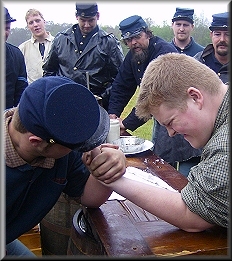
OUR PHILOSOPHY - PREPARATION - For each event, we create a context that puts us into the mindset of the unit we are portraying. Where are they from? What did they do before this point in history? What was the personality of their unit? Their Hometown? Often, this role is centered on the history of a regiment in a particular time-frame or during a historic event.
Thorough preparation ahead of time allows us to fully-enjoy the immersion experience at the event. The following lists contain some of the pre-event research that we have done over the course of the last several years. Please feel free to download to assist with your event research.
A Sample from Craig Hadley's Nineteenth Century Slang Dictionary. Download by clicking here.
Border Ruffians: those living outside the civilized settlements. 1857: A great majority of the people of the West, on the borders, may be emphatically termed Border ruffians. The Eastern people call them by that name. John Taylor at the Bowery, Salt Lake City, August 9. 1860: I only wanted to convince gentlemen . . . that Indianians made better border ruffians than we did. Mr. Craig, Missouri, House of Reps., Congressional Globe, January 4.
Born Days, In All One's: In all one's: lifetime; since one was born. 1840s: Where have you been all your born days, not to know better than that? Sam Slick in England, ch.ii [not] born In the woods to be scared by an owl: refers to one who is experienced and therefore unafraid.
Brick in One's Hat, To Have: To be drunk. 1854: A seedy-looking old negro, with a brick in his old hat, and a weed 'round it. Knickerbocker Magazine, August. bub and sis: brother and sister, especially applied to children. 1872: Many eminently genteel persons, whose manners make them at home anywhere, are in the habit of addressing all unknown children by one of the two terms, bub and sis, which they consider endears them greatly to the young people. Poet at the Breakfast Table, ch.i.
Bucket Shop: A gin mill; a distillery. 1881: A bucket-shop in New York is a low gin-mill or distillery, where small quantities of spirits are dispensed in pitchers and pails [buck- ets]. When the shops for dealing in one-share or five-share lots of stocks were opened, these dispensaries of smaller lots then could be got from regular dealers and were at once named bucket-shops. New York Evening Post, October.
Buckskin: A Virginian. 1824: We suspect that Capt. Tribby Clapp doodled the Buckskins. Franklin Herald, April 13.
OUR FIRST PERSON RESOURCES
Web site with letters from 1861-1865 from Lucy Hayes to her husband - future President Rutherford B. Hayes. For more information please visit the Rutherford B. Hayes web site by clicking here.
A Excellent Article Written By Linda Trent
"A research-based citizen reenacting organization"
Download a template work sheet created by Eric Tipton. Customize for your own event research.
THE NINETEENTH CENTURY SLANG DICTIONARY
1) Rich Mountain Revisited - By Dallas Shaffer - Click Here
2) Yanks From the South - By Fritz Haselberger - Contact the Rich Mountain Battlefield Foundation at (304) 637-7424.
3) 25th Virginia Regimental History - Contact the Rich Mountain Battlefield Foundation at (304) 637-7424.
4) 25th Virginia - Click Here to Visit the Site.
5) 10th Indiana From April 1861, to Rich Mountain - From Mark Jaeger - Click Here to Download the Article.
6) 10th Indiana Quartermaster Reports - Research done by Mark Jaeger - Click Here to Download the File.
7) Rebels at the Gate by Hunter Lesser - Click Here to check it out on Amazon.
MESS NO. 1 FIRST PERSON LIBRARY
1) 4th Vermont - Southern Guard Picket Post - (2004)
2) 5th Kentucky - Battle of Pickett's Mill - (2004)
3) 6th Ohio - Preparation for the Season (2004)
4) 7th Maine - Into the Wilderness - (2004)
5) 8th Illinois - Shiloh Living History - (2004)
6) 8th Illinois - Shiloh Living History - (2007)
7) 8th Ohio - Gettysburg Ohio Remembrance - (2003)
8) 10th Connecticut - War on the James - (2003)
9) 42nd New York - Southern Guard Picket Post - (2005)
10) 52nd Pennsylvania - Fort Sumter - (2005)
11) 56th Ohio - Vicksburg "Life on the Line" - (2007)
12) 149th New York - Lookout Mountain - (2003)
13) 157th New York - Immortal 600 - (2007)
RICH MOUNTAIN


Cap the Climax: To beat all; to surpass everything. 1804: Your correspondent caps the climax of Misrepresentation. Lancaster Intelligencer, February 21. 1811: It caps the climax of French arrogance and turpitude. Massachusetts Spy, September 18. 1821: To cap the climax of his infamy and barbarity, he severed the head from the body of the infant. Pennsylvania Intelligencer, March 21. 1860: All that was wanting to cap the climax to this absurd (Lincoln] nomination was the selection of Hannibal Hamlin as a candidate for Vice-Presidency. Richmond Enquirer, May 25, pp.4-5.
Carryings-On: Frolicking, partying, etc. 1840s: Everybody tuck Christmas, especially the niggers, and sich carry- ins-on-sich dancin' and singin'-and shootin' poppers and sky- rackets -you never did see. Major Jones's Courtship catawamptiously chewed up: utterly defeated, badly beaten. An expres- sion largely confined to the South and West, from at least the 1840s on.
Catch a Weasel Asleep, To: Referring to something impossible or unlikely, in regard to someone who is always alert and is seldom or never caught off guard, e.g., You can't trick old Joe any sooner than you can catch a weasel asleep.
Caution, A: A warning. Also a ludicrous example, or someone or some- thing striking. 1839: Off we hied to the prairie, and the way the feathers flew was a caution. John Plumbe, Sketches in Iowa, p.56. 1840: The way Mrs. N. rolls up her eyes when the English are mentioned is certainly a caution. Mrs. Kirkland, A New Home, p.259. 1851: The way he squalled, rolled, kicked, puked, snorted, and sailed into the air, was a caution to old women on three legs. An Arkansaw Doctor, p.151.
Cavort: To frolic or prance about. 1834: Government's bought their land, and it's wrong for them to be cavorting around quiet people's houses any more. C.F. Hoffman, A Winter in the Far West, p.28. 1845: She better not come a cavortin''bout me with any of her carryins on. W. T. Thompson, Chronicles of Pineville, p. 1 78.
These words and definitions are courtesy of Mr. Craig Hadley's 19th Century Slang Dictionary. All references are contained within the document. To download the full version, please click here. Warning - some words may be considered mature.
Mess No. 1 at The Hornet's Nest - Shiloh, Tennessee 2005 - (From Left-to-Right Front-to-Back Scott Bierer, Evan Zimmerman, Eric Tipton, Jacob Dinkelaker, Eric Grothaus, Mike Davis, Ken Cornett, Mark Susnis, Mike Phineas, Alpheus Lewis, and Joe Liechty.
Bully For You!: Well done; good for you. 1861: Bully for youl alternated with benedictions, in the proportion of two bullies to one blessing. Atlantic Monthly, June, p. 745. 1864: The freckles have vanished, and bully for you. Daily Telegraph, November 18.
Bummer: The original word for bum. A lazy hobo or drunk. 1857: The irreclaimable town bummer figured in the police court. San Francisco Call, April 28. 1860: Another great sham connected with our social life is that of spreeing or bumming. Yale Literary Magazine. 1862: A great majority of the bummers, who so long infested this city, have either left or gone to work. Rocky Mountain News, Denver, May 10.
Bunkum: Claptrap. 1827: This is an old and common saying at Washington, when a member of Congress is making one of those hum-drum and unlistened-to long talks which have lately become so fashionable.... This is cantly called talking to Bunkum: an honorable gentleman, long ago, having said that he was not speaking to the house, but to the people of a certain county [Buncombe] in his district, which, in local phrase, he called Bunkum. Niles' Weekly Register, September 27. 1843: Mr. Weller of Ohio thought the question had been sufficiently debated, for nearly all the speeches had been made for Buncombe. Mr. Underwood, Kentucky, House of Reps., Congressional Globe, December II, p.43.
Candle-Lighting: Dusk. 1810: From dinner to dark I give to Society; and from candle-light to early bed-time I read. Thomm Jefferson, from Monticello, February 26. 1824: The Rev. Mr. Kidwell, a Unitarian Universalist, will preach at the courthouse at early candle light on Sunday evening. Liberty Hall and Cincinnati Gazette, March 26. 1853: The dancing commenced at early candle-lighting, and continued until long after midnight. Turnover, A Tale of New Hampshire, p.80. 1888: The meeting was appointed for early candle-lighting. American Humorist, August.
Mess No. 1 at Into the Wilderness - Virginia 2004 - (From Left-to-Right) Ken Cornett, Eric Tipton, Eric Grothaus, Jacob Dinkelaker, James Renner, and Joe Liechty.
VISIT OUR LINKS

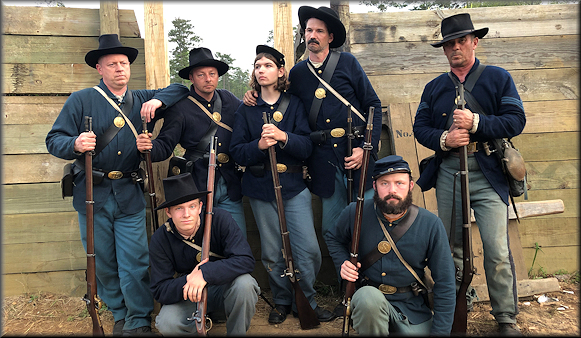
The Assault on Fort Blakeley - Spanish Fort, Alabama - April 5-7, 2019 - Late War Impression. We fell in with the 24th Missouri, representing the 37th Illinois. Event hosted by the Independent Rifles. Pictured are - Front, L-R, Anthony Pugh, Jeremy Snyder. Back - L-R, Ken Cornett, Eric Tipton, Christy Brown, Jason Brown, Mike Phineas. Not Pictured - Seth Hancock.
